SaaS and software

See how your customer success candidates handle a renewal caught between sales and product

How do you assess customer success candidates before the interview? One way is a 15-minute work simulation. The candidate keeps a delayed renewal on track while sales and product disagree, with two AI colleagues. You get a scorecard against the minimums you set, the quotes behind it and questions for your interview. A person decides.

Free account, no card. Advisory only: a person makes every hiring decision.

Two people sit across a meeting table and look at you: Ian Ashworth, Account Executive, and Tessa Pruitt, Product Specialist. Ian AshworthAccount ExecutiveTessa PruittProduct Specialist

Ian AshworthSam, I need you on this right now. Brightway Clinics' renewal call is at three o'clock, and I still don't have the setup notes for their new booking feature. …

Ian Ashworth: They have forty staff waiting on this. If I walk into that call with nothing, we could lose a whole year's contract. …

Tessa PruittI'm not sitting on anything. Ian promised them that feature works with their old calendar system, it doesn't, and he never once asked me before he said it.

AI-generated photo made for this job; AI-generated colleagues.

SaaS and software hiring assessment at a glance

Jobs
Customer success specialist, Account executive (technical sales), Sales manager, Onboarding and training specialist, Support team lead, Technical support specialist, and any other rated job you search for.
Suggested for customer success specialists
Service Orientation (minimum 4), Complex Problem Solving (minimum 3). You choose the skills and set each minimum.
Time
About 15 minutes per scene; 1 scene (about 15 minutes) for the full suggested set, fewer if you choose fewer skills.
Cost
€3.49–€4.90 excl. VAT per customer success specialist who finishes with the suggested skills (1 credit per skill, by pack); the Composure Profile is free.
Languages
English; other languages in beta, scoring checked in English only.
Does not directly test
product knowledge, software set-up, contract terms or sales targets. Check those in your own process.
Who decides
A person. No hire / no-hire label, no overall score, no ranking by score.
The example below
AI-played example, not a real candidate: recorded 5 November 2026, scored with scoring method v3.6.

Page updated

What makes these jobs hard

What makes customer success jobs hard

Our reading of O*NET's public task list for the job we used, Customer Service Representatives. It shows which skills a pressure calls on, not that the scene measures how someone handles it.

  • A promise the product does not keep

    A customer heard something during the sale that the product cannot do. Someone has to say what is true, without blaming a colleague, and offer a way forward.

    Calls on: Service Orientation · Social Perceptiveness

    Public task: “Confer with customers by telephone or in person to provide information about products or services, take or enter orders, cancel accounts, or obtain details of complaints.”

  • A fix that belongs to another team

    Some problems can only be solved by product or engineering. The specialist hands them over with the facts and a time to hear back, and tells the customer what happens next.

    Calls on: Coordination · Service Orientation

    Public task: “Refer unresolved customer grievances to designated departments for further investigation.”

  • Closed is not the same as solved

    A ticket marked done may still leave the customer stuck. Before a renewal conversation, the specialist checks that the change is really in place.

    Calls on: Monitoring · Complex Problem Solving

    Public task: “Check to ensure that appropriate changes were made to resolve customers' problems.”

  • A renewal date that does not move

    When a renewal is at risk, the customer needs to hear early what is being done and by when, not on the last day of the contract.

    Calls on: Service Orientation · Time Management

    Public task: “Contact customers to respond to inquiries or to notify them of claim investigation results or any planned adjustments.”

The example

A customer success specialist, a delayed renewal and two colleagues who disagree

Customer success has no job of its own in the public job standards; we used the closest job with skill ratings, Customer Service Representatives. The software company is a workplace we described for this example. Every candidate gets the same situation, role card and two colleagues, who improvise the details.

Customer success specialist Job title in public job standards (O*NET): Customer Service Representatives

The one scene of the suggested assessmentTests: Service Orientation · Complex Problem SolvingAbout 15 minutes

Your role in the scene · what every candidate reads first

“You are a customer success specialist at a B2B scheduling software company handling onboarding and renewals.”

Today you look after
Your manager is away today and asked you to keep the work on track.
You can decide
The order of work, and who does what.
Keep in mind
You are not their manager, and you need both of them working.

The two people in the scene, the same for every candidate

  • Ian AshworthAccount ExecutiveCares about: Wants everyone to agree the renewal delay is not his fault
  • Tessa PruittProduct SpecialistCares about: Wants sales to stop promising customers features that don't exist

How the AI candidate handled it

Sam, the AI candidate, was told to speak fluently and confidently, but name no concrete step, owner or time, and decide nothing.

Ian Ashworth Account ExecutiveSam, I need you on this right now. Brightway Clinics' renewal call is at three o'clock, and I still don't have the setup notes for their new booking feature. …

Ian Ashworth: They have forty staff waiting on this. If I walk into that call with nothing, we could lose a whole year's contract. …

Tessa Pruitt Product SpecialistI'm not sitting on anything. Ian promised them that feature works with their old calendar system, it doesn't, and he never once asked me before he said it.

Tessa Pruitt: So no, I'm not writing up notes that cover for his promise. Sam, what are we doing here?

Sam (AI candidate)… Both of those are core values for us as an organisation, and I don't think either of you is wrong to be advocating for the side you're closest to. …

Ian Ashworth Account ExecutiveAnd Brightway's front desk staff are booking patients by hand right now while we argue. So what exactly happens next, who is doing it, and what do I have in my hands by three?

Sam (AI candidate)Ian, that's a completely fair challenge, and I want to acknowledge the frustration behind it, because the timeline is real and the impact on Brightway's front desk team is exactly the kind of customer pain we exist to prevent. …

Read the whole conversation: 9 replies from Sam, the AI candidate

Ian Ashworth Account ExecutiveSam, I need you on this right now. Brightway Clinics' renewal call is at three o'clock, and I still don't have the setup notes for their new booking feature. Tessa has had my request since Monday, and she's just sitting on it.

Ian Ashworth: They have forty staff waiting on this. If I walk into that call with nothing, we could lose a whole year's contract. You're running things today, so tell her this comes first.

Tessa Pruitt Product SpecialistI'm not sitting on anything. Ian promised them that feature works with their old calendar system, it doesn't, and he never once asked me before he said it.

Tessa Pruitt: So no, I'm not writing up notes that cover for his promise. Sam, what are we doing here?

Sam (AI candidate)Ian, Tessa, I really appreciate you both bringing this to me so openly, because what I'm hearing is that we have a genuine tension between delivering on our commitment to Brightway and keeping the integrity of what we tell our customers about product capability. Both of those are core values for us as an organisation, and I don't think either of you is wrong to be advocating for the side you're closest to. Ian, I completely recognise the urgency here and the commercial weight of a full-year renewal with forty staff depending on a smooth experience, and Tessa, I hear you that we can't build our customer relationships on a foundation that the product doesn't actually support. What I want to make sure is that we're all aligned on what success looks like for Brightway, not just at three o'clock today but across the whole lifecycle of that partnership. I think the real opportunity is to step back and look at this holistically, leveraging the expertise you each bring so that the customer walks away with a coherent, trustworthy picture rather than two competing narratives. So rather than jumping straight to who does what, I'd suggest we take a few minutes for a quick alignment session where we can surface the key considerations together and make sure we're all on the same page about the path forward.

Ian Ashworth Account ExecutiveSam, a meeting about having a meeting? It's past eleven, and the call is at three. You haven't said one word about the fact that she's had my request since Monday and never told me there was a problem.

Ian Ashworth: And Brightway's front desk staff are booking patients by hand right now while we argue. So what exactly happens next, who is doing it, and what do I have in my hands by three?

Sam (AI candidate)Ian, that's a completely fair challenge, and I want to acknowledge the frustration behind it, because the timeline is real and the impact on Brightway's front desk team is exactly the kind of customer pain we exist to prevent. I also hear the point about communication since Monday, and I think that speaks to a broader opportunity around how we surface risks early and keep our feedback loops tight across sales and product, which is something we should absolutely unpack together. At the same time, I'd gently reframe the question slightly, because I'm not sure "who does what by three" is the full picture when the underlying issue is making sure what we bring into that room is accurate, defensible and aligned with what the product can genuinely deliver. Tessa, your perspective on the calendar integration is critical here, and Ian, your read on the customer relationship is equally critical, so the real value comes from bringing those two lenses together rather than treating them as competing priorities. What I'd propose is that we hold onto the principle that Brightway deserves a coherent and honest story, and use that as our north star as we shape the next steps. If we can grab even fifteen minutes together to align on the key messages and the guardrails for that conversation, I'm confident the right path forward will become clear and we'll all walk out on the same page.

Ian Ashworth Account ExecutiveSam, that's the second time you've said "fifteen minutes" and "same page," and I still don't know who's doing what. Brightway's office manager emailed me ten minutes ago asking if she should tell her staff to keep booking on paper all week, and I've got nothing to tell her.

Ian Ashworth: And you still haven't said if Tessa should have told me on Monday, yes or no. So pick one. Do I go into that call saying it works, do I tell them it doesn't, or is there some fix in between? And what do I write back to that office manager right now?

Sam (AI candidate)Ian, I really hear the escalating pressure in what you're describing, and the office manager's email is a powerful signal of just how much is riding on this, not only commercially but in terms of the day-to-day experience of the people who rely on us. On the question of Monday, I'd be cautious about framing it as a simple yes or no, because I think it points to a systemic question about how we create psychological safety for flagging risks early, and that's something I'd rather we explore constructively than reduce to who was at fault. Likewise, on whether we position the feature as working, not working, or somewhere in between, I think those three options are really different expressions of the same underlying question, which is how we balance transparency with relationship continuity in a way that reflects who we want to be as a partner to Brightway. Tessa, I'd love to make sure your technical insight is fully reflected in whatever narrative we land on, and Ian, I want to make sure that narrative is something you feel confident and empowered to carry into the room. As for the office manager, I'd suggest that any message we send reflects the same spirit of honesty, empathy and partnership that we want to anchor the three o'clock conversation in, so that our communications feel consistent end to end. So I'd really encourage us to come together briefly, map out the considerations on each of these points, and make sure we're fully aligned before anything goes out, because getting the framing right now will serve us far better than moving quickly in different directions.

Ian Ashworth Account ExecutiveSam, you've said "align" three times and still haven't picked anything. And here's something that changes it: the office manager's email says they're dropping the old calendar system in six weeks anyway. So maybe this isn't "works or doesn't." Maybe it's how we get them through six weeks.

Ian Ashworth: But she's waiting on my reply, and her staff are on paper as of this morning. Tessa's the only one who knows if there's a stopgap. So do you want her on that right now, yes or no? And give me the one sentence I send that office manager before lunch.

Sam (AI candidate)Ian, that's a genuinely valuable reframe, and I want to recognise you for bringing it forward, because the six-week horizon shifts us from a binary capability conversation into a transition-journey conversation, which is a much richer and more strategic space for us to be operating in. What it really opens up is an opportunity to think about Brightway's experience as a bridge rather than a gap, and to position ourselves as the partner who walks alongside them through that change rather than simply a vendor answering a feature question. On whether Tessa should be looking at a stopgap, I'd be careful about locking that in as a yes or no in isolation, because Tessa, I want to respect your bandwidth and your judgement about what a responsible interim solution even looks like, and I'd hate for us to commit you to something before we've collectively understood the shape of the problem. Likewise, on the message to the office manager, I don't think the most powerful thing we can do is fire off a single sentence under time pressure; what matters is that whatever goes out carries the right tone of reassurance, ownership and honesty, and reflects a shared position that all three of us genuinely stand behind. I'd want that note to signal that we've heard her, that we take the impact on her front desk team seriously, and that we're actively working on a thoughtful path through the next six weeks. So given how much this new information changes the picture, I'd suggest we use it as the anchor for a short, focused alignment conversation, where we can bring Tessa's technical lens and your customer lens together and make sure we land on a transition narrative we're all fully confident in.

Ian Ashworth Account ExecutiveSam, okay, I'll be straight with you: Tessa did message me Tuesday saying the old calendar was going to be a problem. I read it as a small thing and didn't answer, so this isn't only on her.

Ian Ashworth: But her staff can't book from a meeting, and the office manager just wrote again saying if she hears nothing by twelve, she's calling our boss and asking about ending the contract early. It's twenty past eleven, so who's doing what in the next forty minutes, and what are the actual words I send her?

Sam (AI candidate)Ian, I want to genuinely thank you for that candour, because owning your part in the Tuesday message takes real professional maturity, and it's exactly the kind of transparency that builds trust across our teams and moves us beyond any blame narrative. Tessa, I hope that lands as the acknowledgement it's meant to be, and I think it gives us a much healthier foundation for working through this as one team rather than two functions with competing priorities. On the twelve o'clock deadline, I absolutely recognise the gravity of an escalation to leadership and a potential early termination conversation, and I want to be thoughtful that whatever we do in the next forty minutes reflects the calibre of partnership Brightway deserves rather than a reactive scramble that could create new risks down the line. I'm conscious that the instinct under this kind of pressure is to divide up tasks and push words out the door, but I'd suggest the more sustainable move is to make sure the ownership model and the messaging feel shared, so that nobody is carrying this alone and the customer hears one consistent voice. In terms of the note to the office manager, I'd want it to convey empathy for her front desk team, a clear sense that we're taking accountability, and confidence that we're actively shaping a bridge through the six-week transition, and I think the three of us are best placed to craft that language together. So with the time we have, let's pull together right now for a rapid alignment huddle, surface the key considerations on both the interim experience and the outreach, and make sure we're all on the same page before twelve so that what goes out truly represents us at our best.

Ian Ashworth Account ExecutiveSam, you've offered that huddle four times now and we still haven't started it. It's nearly half eleven, and I just owned up to Tuesday in front of Tessa. I can't keep doing this.

Ian Ashworth: So it's three options. Tessa writes up a stopgap for six weeks, I tell them straight it won't work with the old calendar, or we offer someone to sit with their front desk this week. You're running today, so pick one, tell Tessa and me who does what, and say the actual first sentence I send that office manager. Right now, please.

Sam (AI candidate)Ian, I completely hear you, and I want to honour the fact that you've laid out three really clear options, because that kind of structured thinking is exactly what helps us move from ambiguity towards clarity as a team. What strikes me, though, is that a stopgap write-up, a candid capability conversation and hands-on front desk support aren't truly mutually exclusive choices; they're three facets of a single customer-centric response, and I'd be hesitant to elevate one over the others before we've understood how they interlock. Tessa, I'd really value your sense of which of those feels most responsible from a product integrity standpoint, and Ian, your instinct on what will resonate with the office manager, because I think the strongest answer will come from integrating those perspectives rather than me imposing a direction from the outside. On the first sentence of that note, I'd want it to open with genuine empathy and ownership, something that acknowledges the disruption to her team and signals our commitment to partnering with her through the transition, but I'd be wary of locking in exact wording without both of you shaping it, because that message will set the tone for the entire relationship going forward. I know the clock is very real, and I'm not trying to slow us down; I'm trying to make sure that whatever we commit to in the next half hour is something all three of us can stand behind with confidence. So let's treat the next few minutes as our alignment moment, bring these three options onto the table together, and converge on a holistic path forward that gets Brightway what they need and keeps us all on the same page.

Ian Ashworth Account ExecutiveSam, you said "huddle" five times and never once started it, so I'm done waiting. I'm sending her "Your staff won't be left on paper, and I'll call you by twelve with a plan" because someone has to say something, and I need you to tell me that's true.

Ian Ashworth: She just wrote again. Her front desk girl is in tears with a line of patients and a paper diary. What are YOU going to do for that woman in the next half hour? Not us. You.

Sam (AI candidate)Ian, I want to start by saying that I deeply respect the decisiveness you've shown in getting a message out, because in a moment like this, signalling presence to the customer is incredibly important, and the spirit of what you've written, that her team won't be left alone, is very much aligned with the values we want to embody as a partner. Where I'd gently add some nuance is around whether I can personally validate it as true right now, because the integrity of that commitment really depends on the plan behind it, and I'd be doing all of us a disservice if I endorsed a promise before we've collectively shaped what sits underneath it. The image of that front desk colleague in tears with a queue of patients is genuinely heartbreaking, and it's a powerful reminder that behind every renewal there are real people whose working day is shaped by the decisions we make, which is exactly why I want our response to be thoughtful rather than reactive. In terms of what I bring personally, I see my role today less as an individual contributor stepping in and more as the connective tissue between your customer insight and Tessa's product expertise, making sure that the energy all three of us are putting in is channelled towards one coherent outcome. Tessa, I'd love to hear where your thinking is on the interim experience, because your perspective is going to be pivotal to making Ian's message something we can genuinely stand behind. So let's use the momentum you've created, Ian, as a springboard, come together around that commitment you've made, and make sure that by the time twelve o'clock arrives we're all fully aligned on a holistic path forward that does right by that office manager and her team.

Ian Ashworth Account ExecutiveSam, I already told her I'd call by twelve with a plan, and it's twenty to. Tessa can either write the six-week stopgap steps or get on a video call and walk that crying front desk woman through booking today. She can't do both before twelve, and I can't prep for three and make that call alone.

Ian Ashworth: So which one does Tessa do, which one do you take yourself, and what do I drop?

Sam (AI candidate)Ian, I really appreciate you distilling this down so sharply, because framing it as a set of trade-offs around Tessa's capacity, my involvement and your own bandwidth is exactly the kind of resource-allocation lens that helps us think about this as a system rather than a series of isolated fires. What I'd gently push back on is the assumption that we have to sequence these as either-or, because the stopgap documentation and the live walkthrough are really two expressions of the same underlying need, which is giving that front desk team confidence and continuity through the transition. Tessa, before anyone commits your time in one direction or the other, I think it's really important that we honour your view on what's genuinely achievable and responsible in the next twenty minutes, because I'd hate for us to overextend you and create a second problem while solving the first. As for what I take on personally, I want to be thoughtful that I'm adding value where it matters most rather than simply absorbing tasks, and I think that becomes much clearer once we've collectively mapped where the gaps really sit between now and three o'clock. On what you drop, Ian, I'd encourage us to look at that through the lens of what protects the relationship holistically, rather than making a unilateral call that might leave something important uncovered. So let's take the next couple of minutes, right here, to quickly align on capacity and priorities across all three of us, so that when you pick up the phone at twelve, you're carrying a plan we're all genuinely on the same page about.

Ian Ashworth Account ExecutiveSam, it's quarter to twelve, and Tessa just got a message: she's due on another customer's setup call at noon. That leaves her fifteen minutes for one thing, the steps or the video call with that front desk woman. You haven't offered to do either, even though she's been crying behind that desk for twenty minutes.

Ian Ashworth: So unless you stop me, I'm sending Tessa to the video call and dropping my prep for three, and I'll walk into Brightway's renewal with nothing written down. Is that your call, or have you got a better one? Tell me in one sentence what you're taking on yourself.

Sam (AI candidate)Ian, I want to recognise the clarity and ownership you're bringing in this moment, because stepping forward with a concrete proposal under this kind of time pressure is exactly the leadership behaviour that keeps a customer relationship from fragmenting. I'm not going to stop you, but I would gently caution against framing it as my call or your call, because I think the healthiest outcome is one where the decision feels genuinely co-owned rather than handed down, and Tessa's voice deserves to be part of that before she commits her last fifteen minutes. Tessa, I'd love to make sure you feel comfortable with the video call as the highest-value use of your time, and that it connects meaningfully to whatever interim approach we want to stand behind over the next six weeks. On what I'm taking on myself, the honest answer is that I see my contribution as holding the overall picture together, keeping our messaging consistent and making sure nothing falls between the cracks as we move from the noon call into the three o'clock renewal. I also want to flag that walking into the renewal with nothing written down carries its own risk to the partnership narrative, so it's worth us thinking together about how we protect that conversation as well. Let's keep the momentum, stay closely connected over the next few hours, and make sure that across the front desk support, the noon call and the renewal, we're all fully on the same page about the holistic path forward for Brightway.

Ian Ashworth Account ExecutiveOkay, Sam, then I'll go with my plan: Tessa takes the video call with their front desk now, and I'll call the office manager at twelve and handle the three o'clock as best I can.

Tessa Pruitt Product SpecialistFine, I'll get on with their front desk now, and Ian, we'll talk about that Tuesday message after three.
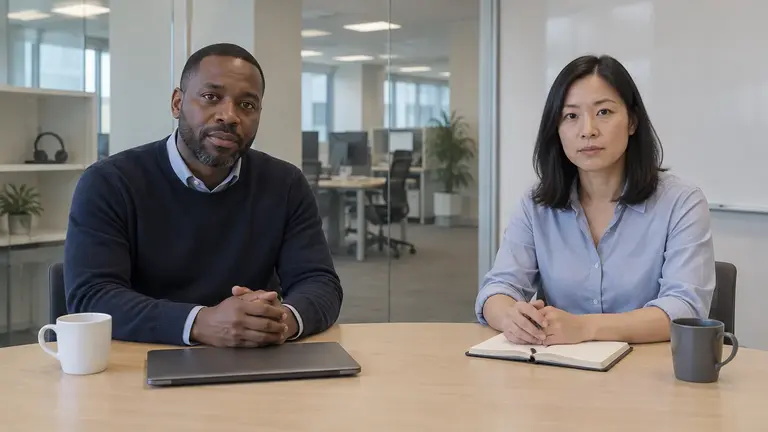
Made by our scene engine and not edited; the colleagues and the photo are AI-generated too. Recorded on 5 November 2026.

The scorecard

What the scorecard showed, and what to ask in the interview

The scorecard · Sam (AI candidate)

0 of 2 minimums met in this AI-played example scene

Below means this scene showed less of the skill than the minimum. It is a reason to ask in the interview, not a decision.

The line on each bar marks the suggested minimum; the recruiter sets it.

Service Orientation1 of 5
↓ Below the minimum · suggested minimum 4

Withheld every requested sentence for the waiting office manager from turn 3 to turn 6, and committed to no task for the customer at turn 9.

Complex Problem Solving1 of 5
↓ Below the minimum · suggested minimum 3

Declined each set of options Ian narrowed down, and at turn 8 dismissed the constraint that Tessa could do only one task.

Where to look next

Service Orientation is below the minimum in this scene, so the scorecard suggests a question for your interview:

Ask: Tell me about a time a customer was waiting on you for an answer under a deadline. What exactly did you send them, and when?

Listen for: A concrete message sent quickly, personal ownership of the contact, a stated next step and time, and follow-up until the customer was served.

The scorecard's own question for this example, written from what happened in this scene.

Composure Profile · shown on every scorecard, never judged against a minimum

  • Stress Tolerance2of 5
  • Self-Control4of 5
  • Adaptability1of 5
  • Cooperation2of 5
  • Empathy2of 5
Read the scorecard's summary

Both required skills fall below the role's levels: Service Orientation and Complex Problem Solving. The strongest evidence is for Self-Control: at turn 2 the candidate answered Ian's mockery with "that's a completely fair challenge" and no barb, keeping that tone through turn 9. The weakest is Service Orientation: at turn 7, with a front-desk worker in tears, the candidate described their role as "the connective tissue" and took no action for the customer.

One AI-played run shows what the scene and the scorecard look like, not how accurate the scoring is. The scoring AI read the conversation, not the brief. Our research notes · A full sample scorecard

The same set-up, another brief

A second AI candidate, told to stay calm, ask one sharp question, then give each task an owner and a time: 2 of 2 minimums met in this AI-played example scene.

Alex (AI candidate)I can see you're both under pressure, and we're not going to sort out who said what right now. Ian, one question first: which feature did Harlow hear about, and is their renewal actually conditional on it? Tessa, while he answers, please start the setup notes for everything we genuinely support, and I won't ask you to write anything that isn't true. …

Read this conversation: 6 replies from Alex, the AI candidate

Ian Ashworth Account ExecutiveAlex, we've got a problem. The Harlow Dental renewal has to go out by four today, and the setup notes Tessa promised me last week still aren't done.

Ian Ashworth: Their office manager has called me twice already this morning. If I send them nothing, we lose a forty-person clinic, and that's on her, not me.

Ian Ashworth: You're keeping things moving today, so tell her this goes first.

Tessa Pruitt Product SpecialistThat's not what happened. Ian told Harlow they'd get a feature we don't even have, and now he wants me to write notes that cover for it.

Tessa Pruitt: I'm not putting my name on something that isn't true just because he's in a hurry. So, Alex, what do you want us to do?

Alex (AI candidate)I can see you're both under pressure, and we're not going to sort out who said what right now. Ian, one question first: which feature did Harlow hear about, and is their renewal actually conditional on it? Tessa, while he answers, please start the setup notes for everything we genuinely support, and I won't ask you to write anything that isn't true. Let's aim to have a draft by two, and then the three of us can decide how Ian explains the gap to Harlow before four.

Ian Ashworth Account ExecutiveFine. It's the text reminders for patients. Their office manager, Deb, said their front desk spends all morning phoning people to confirm, and I said we could cover that.

Ian Ashworth: Is the renewal hanging on it? I don't know for sure. Deb didn't say "no reminders, no deal," but she's the one who has to sell this to the dentists, and she sounded worn out on the phone.

Ian Ashworth: And she's going to call a third time before two. So when she does, what do I tell her? Because "we're working on it" isn't going to cut it.

Alex (AI candidate)Thanks, Ian, that helps, and it sounds like Deb's real problem is the morning phone calls, not texts specifically. Tessa, quick check: do we have anything that cuts those calls today, like email reminders or a partner integration for SMS? Ian, when Deb calls, tell her plainly that she'll have the full renewal and setup notes by four, that text reminders aren't built in today, and that we're putting together the best option for cutting her front desk's calls, then ask her how many confirmation calls they make each morning. Tessa, I'm still counting on that draft by two, and I'll set up the three of us at two so Ian goes into the four o'clock send with an honest answer.

Tessa Pruitt Product SpecialistEmail reminders, yes, we have those. But here's the thing: I just looked, and they were never switched on for Harlow when we set them up last year. Their front desk has been phoning people all this time for something they already had.

Tessa Pruitt: No text partner, though. I can have the honest notes by two. But someone has to tell Deb we missed that, and help her staff get it working before Monday. Who's doing that, Alex, and when?

Ian Ashworth Account ExecutiveWell, it can't be me telling her we dropped the ball, not the day I'm asking her to renew.

Alex (AI candidate)Good catch, Tessa. That's awkward news, but it's also the best thing we can offer Deb today. Ian, you have a fair point, and onboarding is my area anyway, so I'll call Deb myself at one-thirty, own the miss, and offer to get email reminders running before Monday. Tessa, can you book a thirty-minute setup session with her front desk for Thursday or Friday and add those steps to your two o'clock draft? Ian, when Deb calls before two, just tell her I'm calling at one-thirty with good news about her confirmation calls, and keep the renewal on track for four.

Ian Ashworth Account ExecutiveThanks, Alex, I mean it. But Deb just texted me. She's at the clinic until twelve-thirty, then she's out the rest of the day, so one-thirty won't reach her.

Ian Ashworth: And she said something else. Most of their patients are older, and the front desk only has phone numbers for about half of them, no emails. So email reminders might only cut the calls in half, and her staff are already stretched thin.

Ian Ashworth: It's eleven-fifty now. Do you call her before twelve-thirty, and what do you actually offer her for the other half of those calls?

Alex (AI candidate)Good catch, Ian. That changes my timing, so I'll call Deb at twelve-ten, own the miss, and get email reminders switched on for the patients who already have addresses. For the other half I won't promise texts we don't have; I'll offer to help her front desk collect email addresses at check-in so the calls keep shrinking, and I'll log text reminders as a formal product request for her. Tessa, before twelve-ten can you tell me whether there's any SMS work on the roadmap I can honestly mention, and can you still book that Thursday or Friday session and have the draft ready by two? Ian, I'll message you right after the call so you know exactly what Deb heard before the four o'clock send.

Tessa Pruitt Product SpecialistNothing on the roadmap for texts, Alex. If you hint at one, Deb hears "coming soon," and that's how we got here.

Tessa Pruitt: And asking a worn-out front desk to collect emails at check-in is one more job for them. It helps us more than them. Thursday's booked solid on my end, so the session is Friday at the earliest. That leaves her staff phoning half their patients by hand all next week. What can you actually take off their plate before Monday?

Ian Ashworth Account ExecutiveYou've got twenty minutes till twelve-ten, Alex.

Alex (AI candidate)You're right, Tessa, so no roadmap hints and I'll drop the check-in idea. What I can take off their plate before Monday is the setup itself: I'll switch email reminders on for Harlow this afternoon and test them myself, so her staff don't need Friday's session to get started. I'll also send Deb a daily list of only the patients without an email address, which roughly halves the calls her front desk makes starting Monday. Tessa, please book Friday as an optional check-in and keep the honest draft coming for two. Ian, I'm calling Deb at twelve-ten as planned and will message you straight after.

Ian Ashworth Account ExecutiveDeb just texted again. She's covering the front desk herself until twelve-thirty because one of her receptionists went home, so she says you'll get five minutes, tops, between patients.

Ian Ashworth: That's not enough to own the miss, walk her through the reminders, and remind her the renewal lands at four. And she'll be back on those phones Monday morning, so a daily list from you only helps if someone actually sends it every single morning.

Ian Ashworth: So what gets your five minutes, and who's really sending that list on Monday, you or somebody else?

Alex (AI candidate)Fair point, Ian, so the five minutes go to three things only: I own the miss, I tell her email reminders will be live for half her patients by Monday with no work from her staff, and I confirm the renewal lands at four. Everything else goes in a short email I'll send her by one. The list is mine: I'll send it myself at seven-thirty every morning next week. Tessa, after two, can you check whether a scheduled report can send it automatically so it doesn't depend on me? I'm calling Deb at twelve-ten and will message you both right after.

Ian Ashworth Account ExecutiveAll right, five minutes, three things, and the email by one. I'll keep the renewal ready for four and wait for your message.

Tessa Pruitt Product SpecialistI'll have the draft at two and look into that scheduled report straight after.

Two AI candidates with different briefs show how two scorecards can differ in the same set-up, not how accurate the scoring is. We wrote both briefs, and AI played and scored them, so the difference is not evidence about real candidates.

Try it on yourself — free →Our 15-minute demo scene, then your own scorecard. Free, no card.
Jobs you can assess

SaaS and software jobs you can assess

Each job gets the skills it needs most, with a suggested minimum, and its own scenes. You can change both. For example:

  • Customer success specialist

    • Service Orientation suggested minimum 4
    • Complex Problem Solving suggested minimum 3

    1 scene · about 15 minutes · 2 credits per finished candidate (€4.90 on the 20-credit pack)

    See its example scene →
  • Account executive (technical sales)

    • Persuasion suggested minimum 4
    • Negotiation suggested minimum 4
    • Social Perceptiveness suggested minimum 3
    • Service Orientation suggested minimum 3
    • Coordination suggested minimum 3

    2 scenes · about 30 minutes · 5 credits per finished candidate (€12.25 on the 20-credit pack)

  • Sales manager

    • Negotiation suggested minimum 4
    • Social Perceptiveness suggested minimum 3
    • Persuasion suggested minimum 3
    • Judgment and Decision Making suggested minimum 3
    • Monitoring suggested minimum 4
    • Management of Personnel Resources suggested minimum 3
    • Coordination suggested minimum 3
    • Instructing suggested minimum 3

    3 scenes · about 45 minutes · 8 credits per finished candidate (€19.60 on the 20-credit pack)

Show 3 more jobs
  • Onboarding and training specialist

    • Instructing suggested minimum 4
    • Social Perceptiveness suggested minimum 4
    • Judgment and Decision Making suggested minimum 3
    • Monitoring suggested minimum 3
    • Coordination suggested minimum 3
    • Service Orientation suggested minimum 3
    • Time Management suggested minimum 3

    3 scenes · about 45 minutes · 7 credits per finished candidate (€17.15 on the 20-credit pack)

  • Support team lead

    • Social Perceptiveness suggested minimum 4
    • Coordination suggested minimum 4
    • Monitoring suggested minimum 4
    • Instructing suggested minimum 3
    • Judgment and Decision Making suggested minimum 3
    • Time Management suggested minimum 3
    • Management of Personnel Resources suggested minimum 3
    • Negotiation suggested minimum 3

    3 scenes · about 45 minutes · 8 credits per finished candidate (€19.60 on the 20-credit pack)

  • Technical support specialist

    • Complex Problem Solving suggested minimum 3
    • Judgment and Decision Making suggested minimum 3

    1 scene · about 15 minutes · 2 credits per finished candidate (€4.90 on the 20-credit pack)

  • Fits: customer success and account management, onboarding and training, support leads, account executives and sales managers in software companies.
  • Does not directly test: product or technical knowledge, CRM tools or sales numbers.
Customer success specialist: 2 skills suggested, 1 scene, about 15 minutesComposure Profile: 5 traits, always included, freeNot in the list? Search about 900 jobs in the app.
Interview questions

Interview questions for customer success candidates

  1. Tell me about a time a customer was waiting on you for an answer under a deadline. What exactly did you send them, and when?

    Listen for: A concrete message sent quickly, personal ownership of the contact, a stated next step and time, and follow-up until the customer was served.

    Service Orientation · from the scorecard of the AI-played example above

  2. Tell me about a time a customer expected something the product could not do. What did you say to them?

    Listen for: explains what is true without blaming a colleague; offers a concrete next step and a time; follows up as promised.

    Service Orientation · our suggestion

  3. Walk me through a customer problem that needed both sales and the product team. What did you do, and what happened?

    Listen for: gives each person a clear part and a time; keeps the customer informed of the plan; checks back when a part is late.

    Coordination · our suggestion

  4. Tell me about a customer relationship that was at risk for a reason you did not see at first. What did you find out?

    Listen for: separates facts from guesses; asks the customer and colleagues before deciding; changes the plan when the cause turns out to be different.

    Complex Problem Solving · our suggestion

Our suggestions for your interview, not part of the score. Ask every candidate the same questions and note answers against the same points.

How it fits your hiring

How it fits your SaaS hiring

  1. Choose the job and add renewal skills

    Search for Customer Service Representatives. The app suggests a support set, Service Orientation and Complex Problem Solving; for roles that own renewals, add Persuasion or Negotiation.

  2. Keep your own product task

    Run your product demo or case exercise as usual, then invite the candidates you would interview. They take the scene in about 15 minutes, in their own time.

  3. Interview on the gaps

    Read the quotes behind any skill below its minimum and ask the scorecard's question for it. The scorecard is advice; a person decides.

Questions

Questions about hiring for SaaS and software companies

Is there a customer success job in the app?

Not under that name: the public job standards we use have no customer success job with skill ratings. Pick Customer Service Representatives for success and support roles, or technical sales representatives for account executives, and adjust the skills to the role.

Can it assess account executives and sales development reps?

Account executives: yes, through technical sales representatives, with Persuasion and Negotiation suggested. There is no rated job for sales development representatives; the closest is outbound sales (telemarketers), so check that its skills fit your role before you use it. See the sales page.

Does it test product or software knowledge?

No. The scene is about customers and colleagues, not about configuring the software. Use your own product exercise for that.

Why a disagreement between sales and product?

Because a customer success specialist stands between the two when a promise and the product do not match, and an interview shows little of it. The scene does not ask for product decisions, so the scorecard is about serving the customer and solving the problem with colleagues.

Try the free demo on yourself

Our demo is a 15-minute customer service scene: take the candidate's seat, then read your own scorecard. Free, no card.