What it is
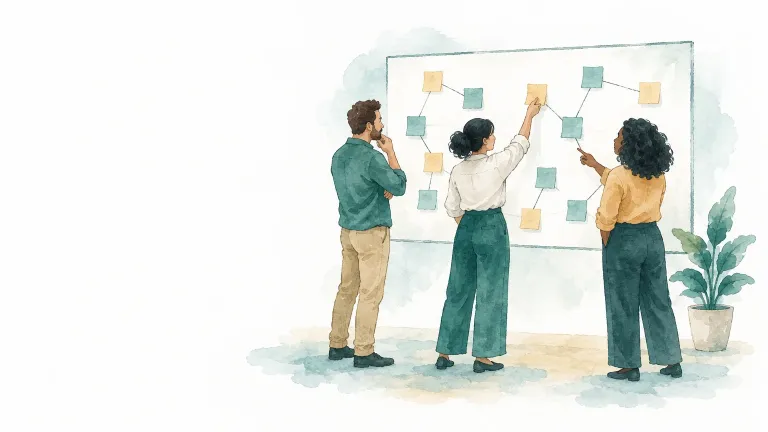
Fits their own and other people's actions into one plan, who does what and by when, and re-plans when someone's situation changes. It is not the same as being organised on your own, with a neat to-do list. It is also not doing everything yourself so nothing can go wrong. The skill is about several people's work fitting together, and about changing the plan out loud when one piece moves.
What it looks like at work
- Fit everyone's work into one plan
- Agree who does what, by when
- Re-plan when things change
- Healthcare
A charge nurse agrees at the start of a shift who covers which rooms and who takes the admission due at noon, then redoes the plan when a colleague is called to an emergency.
- Software
A software developer agrees with the tester and the database colleague who finishes what first, so the release can be tested on Thursday, and moves the date for everyone when one change slips.
- Construction
A site foreman orders the work of electricians, plumbers and plasterers so that no trade stands waiting for another.
- Finance
An accountant at month-end agrees which colleague sends which figures by Wednesday so the report is ready on Friday.
- Retail
A retail supervisor plans a sale day (delivery, shelf filling and till cover) and changes the plan when someone calls in sick.
In each case the person makes clear who does what and by when, and tells the others when that changes.
Why it matters in different kinds of jobs
Most work depends on other people's work. When it goes wrong, it usually goes wrong at the hand-offs: two people both think the other one is doing it, or one person waits for something that is not coming. In small teams this is handled in a quick conversation; in larger projects, hospitals or building sites a missed hand-off can cost days or put people at risk. Research on teams describes coordination as one of the core things teams do while they work, and finds that how well teams handle such processes relates to how well they perform (Marks, Mathieu & Zaccaro, 2001; LePine et al., 2008). That is research about teams, not a test of individuals, but it shows why one person who keeps the plan straight matters. Team training studies also find that these processes can be improved with practice (Salas et al., 2008).
Why interviews often miss it
Asked about teamwork, candidates tell success stories in the "we" form. It is hard to tell who made the plan, who noticed the gap and who only followed. Reviews of interview research find that structure helps: the same questions for everyone, follow-up questions and a rating guide (Levashina, Hartwell, Morgeson & Campion, 2014). Even then, you hear how the candidate remembers the plan, not how they built it.
How a work situation can show it
A realistic work situation can give the candidate a task that needs several people and a plan that has to change part-way: someone becomes unavailable, or a deadline moves. You then see whether the candidate says who does what and by when, checks that others have understood, and re-plans openly when the situation shifts.
What to ask in an interview
"Tell me about a piece of work that depended on several people finishing in the right order. How did you agree who did what and by when?"
Follow-up: "How did everyone know the plan?"
"Describe a time a plan fell apart because one person could not deliver. What did you change?"
Follow-up: "Who did you tell, and when?"
"When did a hand-off between you and a colleague go wrong? What do you do differently now?"
Listen for names, tasks and times, not only "we worked well together".
To see it with a situation from your own job, read how it works and pricing.
What hire.center shows, and its limits
In hire.center, a candidate handles one realistic work situation built from the job. The scorecard shows the candidate's own words for each skill the recruiter chose, or says there was not enough evidence. One situation shows one situation, not the whole job, and it does not test technical knowledge. A person makes the hiring decision. Our quality checks so far use AI-played candidates in six example jobs, most of them with customers or colleagues at the centre of the work. We are extending them to more kinds of jobs.
Sources
- Marks, Mathieu & Zaccaro (2001). A temporally based framework and taxonomy of team processes. Academy of Management Review, 26(3), 356–376
- LePine, Piccolo, Jackson, Mathieu & Saul (2008). A meta-analysis of teamwork processes: Tests of a multidimensional model and relationships with team effectiveness criteria. Personnel Psychology, 61(2), 273–307
- Salas, DiazGranados, Klein, Burke, Stagl, Goodwin & Halpin (2008). Does team training improve team performance? A meta-analysis. Human Factors, 50(6), 903–933
- Levashina, Hartwell, Morgeson & Campion (2014). The structured employment interview: Narrative and quantitative review of the research literature. Personnel Psychology, 67(1), 241–293